Optimal Transport & Operations Research
I am interested in using optimal transport structure to develop efficient algorithms for operations research, particularly mixed-integer optimization problems with large transport subproblems.
OTBD
GPU-accelerated optimal transport for mixed-integer optimization
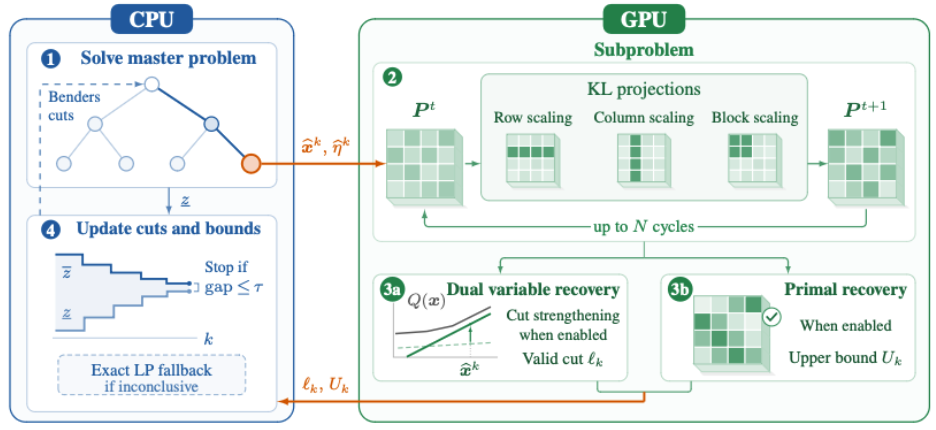
OTBD accelerates repeated transport subproblem evaluations using entropy-regularized optimal transport, GPU-friendly scaling, and KL projections. Applications include capacitated p-median, hub transport, and facility location problems.
CPU–GPU workflow
The CPU solves the master problem, while the GPU evaluates the transport subproblem through KL projections. Dual recovery produces valid cuts; optional primal recovery provides upper bounds. Cut strengthening can improve the recovered cuts, and an exact LP solve is used when the available bounds are inconclusive.
Computational results
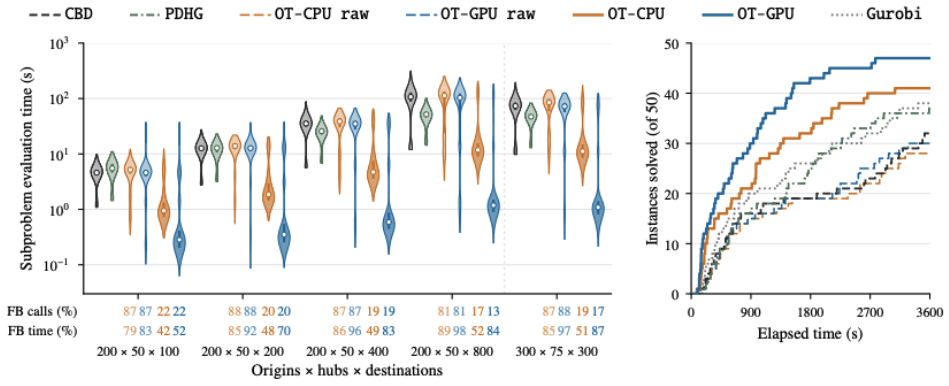
In the illustrated experiments, GPU OTBD achieves nearly two orders of magnitude faster subproblem evaluation at certain problem sizes than conventional CPU subproblem solves.
Across 50 three-index hub transport instances, GPU OTBD reduces mean subproblem evaluation time by 85.7% relative to the baseline using exact CPU LP subproblem solves. It solves 47 of the 50 instances within one hour, compared with 32 for that baseline.