Numerical Methods for PDEs
My work spans numerical methods for PDEs, machine learning in PDE fields, and their integration for scientific computing.
Goal-oriented mesh adaptation
A central theme of my work is adjoint-based mesh adaptation. During my Ph.D., in joint work with my advisor Prof. Guanghui Hu, I developed an automatic dual-consistent mesh adaptation method for the steady Euler equations within AFVM4CFD, the CFD library maintained by our group, and proposed a hybrid CNN+Dual approach that significantly accelerates the adaptation procedure.
Multi-mesh methods for multiple target functionals
Real applications often involve nonlinear or composite functionals beyond simple drag/lift, where existing theoretical guarantees no longer apply. A multi-mesh framework offers a principled way to handle such cases by allocating an adapted mesh to each target.
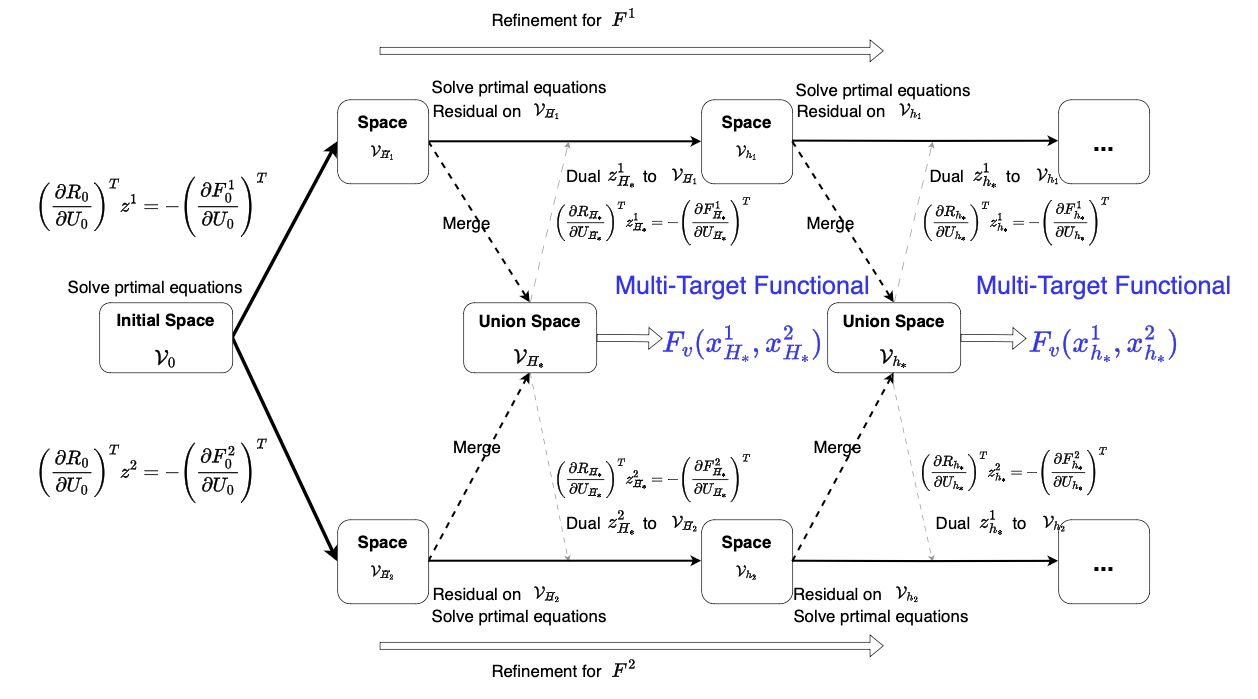
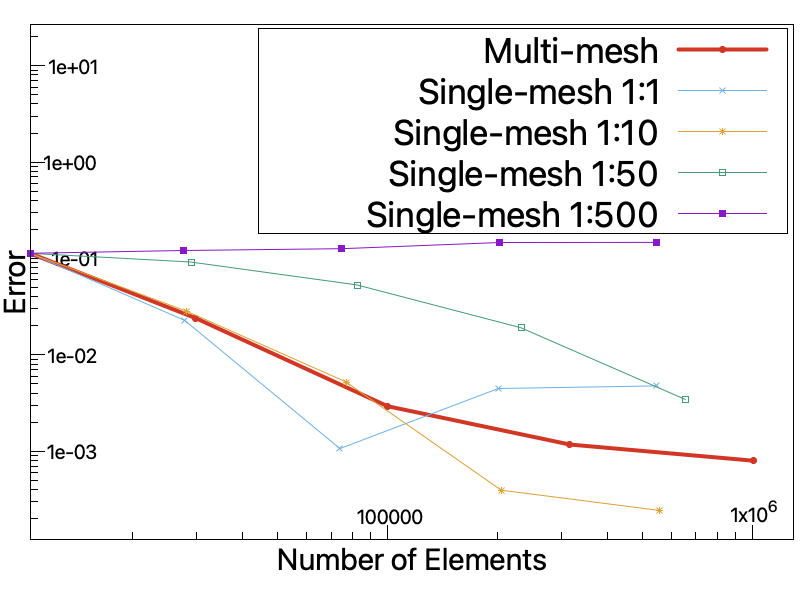
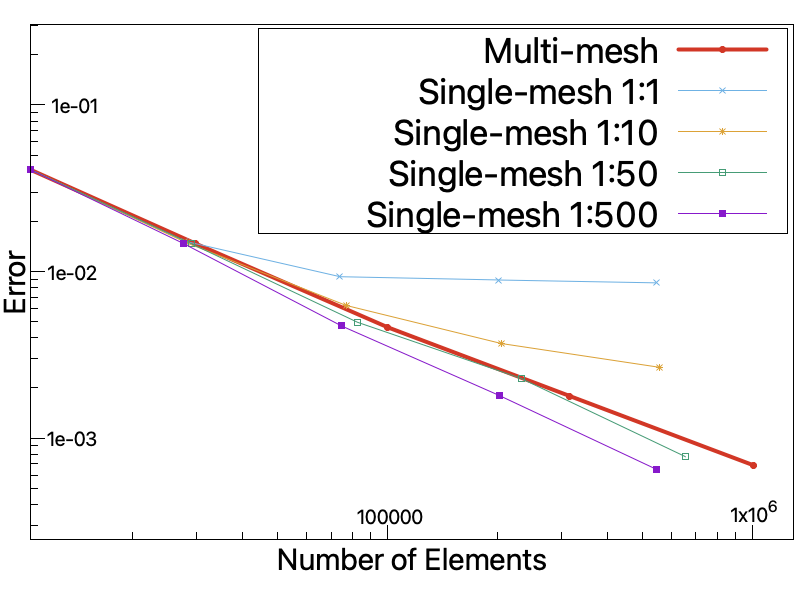
Towards more realistic models. The current framework relies on the steady Euler equations with mirror-reflection boundary conditions. Capturing boundary-layer effects in airfoil shape optimization will require richer models such as Navier–Stokes and Boltzmann equations.
Machine learning for PDE-based optimization
I view machine learning as a complement to classical numerical methods. My recent work explores reinforcement learning for shape and geometry optimization, with classical-method-informed learning frameworks: e.g., airfoil shape optimization driven by a CFD solver, and molecular geometry optimization driven by DFT.
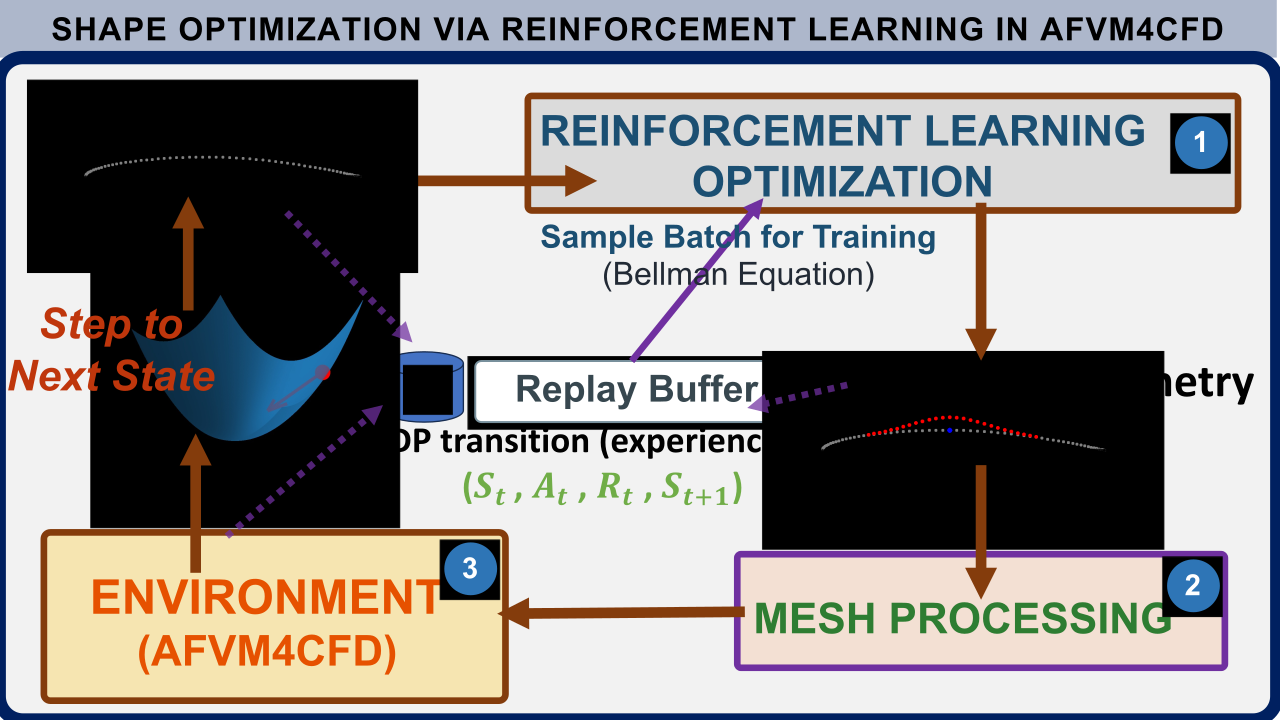
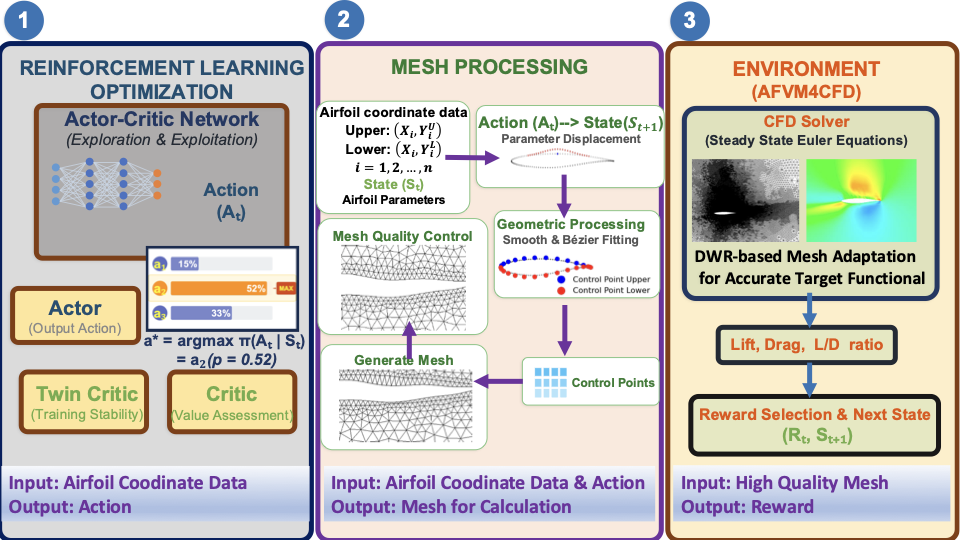
Multi-agent exploration. Multi-agent training accelerates data collection—a classical bottleneck of RL exploration—and naturally accommodates conventional optimization tools such as the adjoint method within the learning loop.
Data-driven discretization with classical structure. Classical discretization remains indispensable for an efficient and credible solver: it informs network design (e.g., handling rotational/translational invariance in molecules, or non-smooth airfoil geometries) and provides reliable evaluations during optimization. I am developing data-driven discretizations that retain these structural guarantees while leveraging the speed of learned components.
Tutorials
Mesh operations with AFEPack
Materials from my Tianyuan Mathematics Center short course on finite-element computation and adaptive meshes using AFEPack. Examples progress from a P1 Poisson solver to residual-based and goal-oriented refinement, dual problems, mesh merging, mesh motion, and shape optimization.